Showing posts with label Poland. Show all posts

20 June 2010

The Jewish Plight: Auschwitz-Birkenau

While I hate to say that a WWII death camp is a must-visit, Auschwitz truly shows just how heartless, horrible, and extensive the Nazi's "final solution" was...something you can't experience from reading books or seeing pictures. Named for the town of Oswiecim in which it stands (Auschwitz is its German name), Auschwitz was divided into three camps (I, II [Birkenau], and III) and was the largest in the German camp system.

When visiting the Auschwitz complex, some say to visit Auschwitz I if you are short on time. After all, there is much more to see there: buildings completely reconstructed, artifacts stolen from the Jews and compiled (glasses, fake teeth, even hair shaved from prisoners), and a concise history that helps tell the story of life in the concentration camps. In Auschwitz I, prisoners were kept alive, experimented upon, or forced to work under impossible conditions. In Birkenau, however, all that existed was death and those who worked for it.


The first thing you see upon arrival to Birkenau is a dominating, red brick watchtower and gate. From the outside, it appears like a grandiose entrance way, much the same as Brandenburg Gate or the Arch de Triomphe might seem. And perhaps this is how Himmler saw it as well. But as you walk through and see what hides behind its facade, feelings being to overwhelm and the void on the other side overtakes.

To the left and right are open fields, where the prison buildings once stood. Now it is a half mile of emptiness on each side. To the front, a single railroad track (ominously foreshadowing that people come in but not out) leads 1.5 miles ahead, terminating at the crematoriums (5 in all). This is where 1.1 million people were never given a chance, chosen not for who they were but for who they were not, and killed systematically...banefully...inhumanely.
And making the walk from entry to crematory makes it all the more real.

The crematoriums are gone; the prison buildings are destroyed. Now all that remains is the gate, the tracks, and the feeling of hollowness that Birkenau's massive expanse leaves behind.

17 June 2010

The Jewish Plight: Krakow

While Warsaw saw the most physical destruction during WWII, Krakow's Kazimierz district and its Jewish history is probably the most familiar. It's proximity is not only the closest to well-known Auschwitz-Birkenau extermination camp, but it was also home to the Jewish savior made popular Steven Spielberg: Oskar Schindler.

Schindler's enamel factory, now a museum, lies just outside Krakow's Jewish district. Here, hundreds of Jews were employed
under the auspices of "necessity to the war effort" and saved from the gas chambers. As depicted in the film, Oskar Schindler's original motivations were monetary. But as the war went on and more Jews were employed, his loyalties shifted to his workers despite their Jewish ethnicity. Taking a walk in the Kazimierz district, you might encounter scenes where Schindler's List was filmed. (These pictures are from the scene where mother is separated from daughter while trying to hide from the Nazis, then reunited under these stairs.)
But more disheartening than the extermination of the Jews and the risk Schindler took in their protection is the lack of a Jewish community here today. After the war, anti-semitism continued to thrive through the late 1960s. Following the Six-Day War between Israel and the Egypt/Jordan/Syria region (in which Israel came out victor), anti-semitic tensions continued to escalate in Poland and finally culminated the following year. Massive student protests, sparked by censorship of Poland's national poet of Jewish heritage, ended with more than 2,500 arrests. Jewish organizations were shut down, Yiddish was banned, and most Jews
by then had emigrated out of Poland.

Though anti-semitism does not thrive overtly, the residual effects are still apparent. The Jewish population was decimated by discrimination and people still hide their Jewish heritage. In fact, it is not uncommon for daughters and sons to discover their true heritage only as a final revelation by their parents on their death beds. Even today many Jewish Krakovians feel compelled to hide who they are.

08 June 2010

The Jewish Plight: Warsaw

Modern-day Warsaw, Krakow, Prague, and Berlin appear like any other cities in today's worldwide spectrum. They all tout successful tourist industries, beautiful architecture, blossoming economies, and heartbeats that distinguish them as unique in their own regard. But what sets them apart from others, and unites these 4 cities as one, are their tragic connections to WWII's holocaust and the atrocities experienced by each. My own exploration, education, and reflection began in Warsaw...

Walking through Warsaw today, it appears like any Eastern European city. Impeccable public transit, modern shopping malls, and new buildings flanked by socialist architecture of bygone days. But be careful...a tourist could easily flit around this city visiting Old Town, the Royal Walk, and Palace of Culture and Science and leave none the wiser to Warsaw's poignant past. But here in this now modern and beautiful city, the plight of the Jews was by far the most tragic.

Of the ghettos established by the Nazi regime, Warsaw's was the largest. Nearly 30% of Warsaw's population (~400,000 people) was forced into an area less than 3% the size of Warsaw. Conditions were difficult, disease rampant, and starvation and random shootings an everyday occurrence. Though buildings of the ghetto were mostly destroyed as Warsaw was "razed to the ground," the site of its Umschlagplatz (literally "reloading point") can still be visited today. Here, nearly 300,000 ghetto residents in just under 2 months
(about 7,000 each day) were gathered, loaded on trains, transported to Treblinka death camp, and killed in gas chambers.

While some met their untimely death at Treblinka, the more influential and dangerous faced interrogation at Gestapo headquarters. The headquarters was located in the basement of Poland's current-day Ministry of Education building, and today appears
much as it did during Hitler's reign. Bench rows set up like a train (flanked and one behind another) is where Jewish "conspirators" would sit for days not being allowed to sleep. During interrogations in the rooms nearby, music would play from a wireless radio outside the "train room" door. This would muffle speech, screams, and other sounds of torture and death from those awaiting the same fate. At the end of the WWII, 5.5 tons of cremation ash was found in the Gestapo headquarters building.

While often we hear about Nazi atrocities such as these in discussions of the holocaust, one thing rarely brought to life are the circumstances perpetuated by the Russians during the Warsaw Uprising (which I find to be just as cruel and inhumane as the gas chambers). Not to be confused with the Warsaw Ghetto Uprising which occurred a year earlier, this 1944 resistance movement intended to free Poland from Nazi control. Knowing the Red Army was within range to help liberate Warsaw, the Polish Home Army led attacks on their Nazi occupiers on Aug 1.

While the uprising intended to hold the Nazis in check for mere days until Russian help could come, the Polish defenders bravely fought until their eventual surrender 63 days later. The Russian Army, wanting Warsaw under their control, stopped at the gates and waited for months until Polish defeat. After all, it would be easier to control a defeated people than one which had succeeded. When the Russians final entered Warsaw, 85% of the city was destroyed.

What you see today in Warsaw is a symbol of strength. A city rebuilt, a city pride that can't be extinguished, and a city which remembers. It is our duty as visitors to remember, too.

*As usual, I thank wikipedia for historical background information.

25 May 2010

An Eastern European Easter

In the United States, Easter tends to fall low in rank – somewhere between MLK day and Cinco de Mayo I'd suspect. Not even as anticipated as Fourth of July, this step-child holiday comes and goes without outrageous commercialism or holiday-time parties. But in Eastern Europe, the Easter Season puts even our Christmas celebrations to shame.

Krakow’s Easter Market engulfs the main square. Towers of flowers decorate for festivities and reach high above the Easter crowds. Banners announcing Easter concerts invite even the most apprehensive
to join the celebration. Piles of handmade baskets pour out of vendor stalls enticing buyers inside, while neighboring stalls sell anything from ceramics to woodwork to crocheted egg toppers. Even the malls take part in the celebration with Easter displays and decorations strategically placed in windows, stores, and common areas.

Palm Sunday Mass is no small production either. With organ-led melody, the Passion is recited in solo song with two choirs (in the choral terrace and behind the alter) volleying in strategic accompaniment. Carrying braided straw decorated with ribbon (instead of our traditional palm sprigs), Mass attendees vie for standing-room-only. Those lucky enough to find seats must still be herded slowly from pew to portal at Mass’ end.

But end of Mass doesn’t mean end of celebration. Reenactments of Christ’s Palm Sunday procession head toward the main square while Krakovians join along in traditional dress holding torch-like flower arrangements above their head. Easter music floods the square, and local vendors offer a spring-time specialty,
Ocsypki – salty, grilled ewe's cheese served with a side of cranberry sauce.

Prague joins Krakow’s Easter celebration with as much eagerness or more. Church bells from the hundreds of Catholic, Hussite, and Orthodox churches announce Easter Sunday Masses. St. Vitus, Prague's national cathedral, invites celebs like cardinals and bishops to conduct the sacred sacrament. Full choirs sing angelic praises and
low timbre organ music makes you think the Lord himself is entering, vibrating the pews and the people in them. And staying true to Prague international reputation, the Cardinal welcomes the congregation in four different languages and translates his homily into three.

Prague’s own Easter markets speckle main squares around town selling handpainted eggs in every color and design imaginable. The sweet smell of baked dough and almond (from spiraled, sugary pastries) fills the air. Local men (and tourists, too) purchase straw whips for their Easter Monday tradition – whipping the ladies in exchange for Easter eggs, candy, or brandy.

You haven't truly celebrated Easter until you've seen it in Eastern Europe.

09 May 2010

Old World Charm

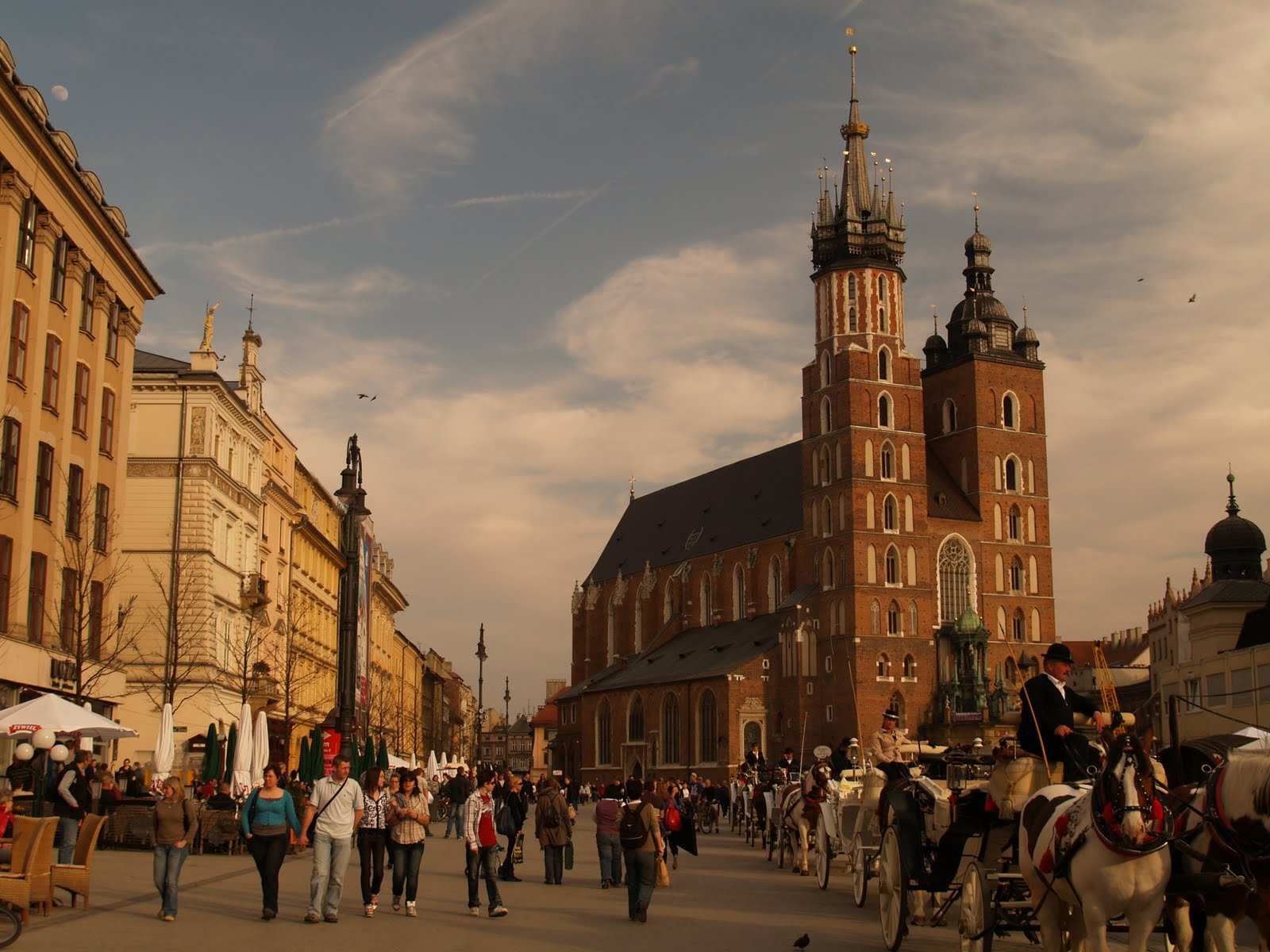
Stepping into Krakow is like stepping back in time. With much of its medieval architecture surviving, you truly get a sense of the Old World. Red-roofed buildings with dominating facades tout a mixture of baroque, Renaissance, and Gothic styles. Coupled with cobblestone streets and impeccably preserved architecture (even the McDonald's opens its Gothic cellar to diners), one could easily lose themselves in time and space.

The Old Town and its square (Stare Miastro) are still lined with shops and bustling with vendors and consumers mu
ch as it was centuries ago. Though now people barter with money and trade for trinkets, you truly get the feel for what this market square once was. Dominating the square is Krakow's Sukiennce – once a major center of international trade and business negotiations, this Cloth Hall still functions today selling items of superfluity rather than necessity.

Seeing much prosperity during the Renaissance, Krakow still boast remnants of its Golden Age. Krakow embraced with alacrity the art, architecture and free thinking of this era. And who better to put Krakow on the map as the center for European Renaissance than the proponent of heliocentricism himself – Nicolaus Copernicus. Educated in Krakow at one of Europe's oldest university's, you can still visit the courtyard of Collegium Maius where Copernicus once studied and roamed.


Medieval charm and Renaissance resplendence will entice the curious and apprehensive alike. In fact,
the only thing lacking charm is the city's name – Krakow literally means "City of Krak" (and the most expensive real estate in town – the top floor of the "Boner Palace," a mighty erection indeed).

06 May 2010

Luck of the Polish

Unlike Warsaw that saw most of its history and everything that stood for it razed to the ground, Poland's former capitol suffered little damage during the world wars and appears much as it did centuries ago. Why Krakow was spared, no one knows for sure. But German immigrants did build much of what stands today, so perhaps a feeling of entitlement and good German pride were enough to save it from destruction.

It wasn't just German occupation either that threatened thi
s city's history and charm. After all Krakow didn't gain complete independence until after World War II despite its long history. After nearly being destroyed by Tartar raids in the 13th century, it was imperiled by foreign king succession and rule, a Swedish invasion, and numerous partitions by Prussia, Russia, and Hungary. By the time the German's got to it, it was a small miracle the city was still standing!

Krakow hasn't just survived these times discord and potential destruction; it has come out of this harsh history practically unscathed! The inner wall of the city, which protected Krakow from the Tartar invasions, still stands. Jagiellonian University's
Collegium Maius has educated its students since the late 15th century. Kings have been coronated on the historic Wawel Hill since 1320. And the prominent Barbican, built in 1499, was never tested in battle.

Perhaps divine intervention played a role in protecting the city for so long. Krakovians actually have a saying that if Rome weren't Rome, Krakow would be Rome. With so many churches – and of course Krakow being the city where Pope JP II's academic, linguistic, and spiritual propensities blossomed – it's difficult
not to believe the good Lord had a hand in its survival.

Or perhaps we've simply misjudge European luck all this time. I mean the Irish may have been fortunate, but I think "Luck of the Polish" is a bit more apropos.

26 April 2010

Potato Pancakes, Pierogi, and Other Polish Pleasures

While Poland is probably known more for its recent tragic history than anything else, one thing that sustained war and strife is its rich culinary heritage. From delectable drinks to traditional fare, Poland’s food is sure to please.

Soups with bread for dipping is a must for Polish cuisine. Made from homemade and thick tomatoes or the lighter sweet and sour beet root, the cold weather necessities this starting course. Paired with the traditional Polish pilsners like Zywiec or Okocim, cold drinks complement the warm starters well. But for those looking for a bit of the “special” in their choice of beverage, try the hot chocolate. This Polish specialty is literally what the name implies: thick rich melted chocolate available in white, milk, or dark.

As for main courses, plate-size potato pancakes, softball-size pork knuckle, and Kielbasa served street-side are musts. And the late night cuisine of choice? Zapiekanka. This Polish style pizza served on baguette topped with cheese, ketchup, and choice of topping complements well an evening of beer drinking. But bring a friend when you order...you may need a bit of help eating it!
While potato pancakes, pork knuckle, and pizza are staples in Polish cuisine, the king of them all is pierogi. Arriving in quantities from 6 to 12, these Polish ravioli-type snacks come in all tastes and flavors. Fillings range from potato with cheese (Ruskie) to spinach to groats and liver (Kresowe) and are typically topped with onion infused oil and pork drippings if you’re lucky. Or for a bit of a gourmet twist on the traditional try pierogis stuffed with lentil, chicken, or chickpeas.

Polish cuisine is more than just a pleasant surprise, it's a truly pleasurable culinary experience.

19 April 2010

A City of Music

Never have I visited a city where music is so much a part of the everyday. Both in concert and improvisational, you can’t wander too far in Warsaw without hearing piano concertos, violin solos, or melodious ensembles. Even Warsaw’s airport pays tribute to this fact, having been named for its famed composer Frederic Chopin.

Taking the Royal Walk along Krakowskie PrzedmieĊ›cie shoves you right into the musical world of Warsaw. Benches inscribed with tidbits about Chopin’s life play recorded piano music upon prompting. Chopin even left a tidbit of himself on the Royal Walk – his heart is in the left-side pillar of Holy Cross Church under the biblical inscription "For where your treasure is, there will your heart be also." At the end of the Royal Walk you’ll find the home of probably the most ornate (and ostentatious) organ you’ve ever seen. Dominating the choir coral at the back of St. Anne’s Cathedral is a gilded silver and gold organ (the picture, compliments of nzorgan.com, just does not do it justice). Visit St. Anne’s for Mass and you’ll be pleasantly rewarded with organ and solo tenor duets throughout the service.

The Royal Castle also celebrates the city’s love of the classical by frequently offering chamber music concerts within its royal walls.
The palace’s Great Assembly Hall instantly transports you to a time when composers were like gods, white wigs were the fashion, and the luxuries of the rich were celebrated without reserve. Concertgoers are seated in velvet cushioned chairs surrounded by gold trimmed mirrors and marble columns. Twenty gilt bronze scones strategically line the walls between mirrors and crystal chandeliers delicately light the chamber. With seating for just a small crowd, it shows the audience how chamber music gets its name. Despite the room's "large" name, listeners sit in close quarters with room for just a couple hundred. The acoustics of the room, assisted by its small size, delicately swirls the music of small ensembles above, around, and between listeners as it is isolated, blended, and resolved. Listening to chamber music in situ is an experience that truly can't be replicated.

But music isn't just isolated in concert halls and royal palaces. Just take a walk around the Old Town and you'll see what I mean. Out of a second story balcony, a woman hangs her laundry as recorded orchestra music floats out from French doors. Music students lay violin cases street-side while playing Vivaldi’s Spring in exchange for tips. And out of a basement window, bassoon and trumpet warm up chromatically while the strings of a violin whine as they are tuned.

For the many tourists and locals, music is what makes the town. But perhaps it is possible to have too much of a good thing:

16 April 2010

Walking the Walk in Warsaw

Walking is the only way to see Warsaw. With hundreds of must-sees within this bustling city, the majority of sites are walking distance from the main city center. And even for the tourist who is averse to walking, Warsaw makes it easy. The 2.5 mile Royal Walk in the heart of the tourist district lines itself with the more notable sights and beautifully reconstructed architecture. The Old Town Square just north of the walk immediately brings you back to an age of renaissance. With performing minstrels, colorful architecture, and a European propensity for outdoor-eating venues, it has been so accurately reconstructed that UNESCO named it a World Heritage Site.

From here Castle Square provides a Royal Entrance to the Roy
al Walk. The red-brick facade and clock tower of the Royal Castle dominate the square during the day and at night is eerily illuminated. Once the seat of Polish monarchs, it now sees thousands of visitors every day and serves as a venue for governmental meetings and concerts. But perhaps its most impressive characteristic isn't its imposing structure; rather, it is the two Rembrandts hung side-by-side within its walls.

Leaving the castle and continuing to walk down
Krakowskie PrzedmieĊ›cie, any Warsaw walker will immediately note the lack of cars....really, could Warsaw make this any easier? Not only are most sights within walking distance, but the street along which they reside is a cobblestone and brick pedestrian walkway.

While sights like St. Anne's Church, Hotel Bristol, University of Warsaw, and
Staszic Palace please the eye, even the Royal Castle is not what's most notable about this walk. What is truly amazing is that only 60 years ago, the Royal Walk and Old Town were completely destroyed. The impeccably reconstructed city, along with it a reconstructed Polish pride, is a testament to the Varsovian people...a people who have truly walked the walk.

12 April 2010

Wanderng About Warsaw

It didn't take long, did it. Less than 6 months back in the States and wanderlust got the best of me. Truth be told, I had a conference to attend. That's what brought me to Warsaw. But why not play tourist for a bit while I'm here, right?

I'm not sure what I expected to see upon arrival in Poland. Perhaps a bit run down, yet functional? Maybe a bit depressing, yet still potential for a good time? After all, the devastation seen by Warsaw and its people is only recent history. But the city has come back with avengeance. Despite being "razed to the ground" during Nazi occupation, almost a third of its population being killed, and decades of post-WWII communist leadership, Warsaw is worth your time to wander.


Diversity of architecture is an understatement to day the least. Old Town reconstructions and cobblestone streets pay tribute to the buildings that once were, and scattered among these are communist-era "quick-fix" buildings that still stand tall. Both stand side-by-side with modern shopping malls that could challenge (in both size and construction) those found in the States.


The city is impeccably clean. Rubbish lying street-side is practically non-existent, and the street cleaning crews (who obviously take their jobs very seriously) meticulously scrape gum residue from sidewalk surfaces as part of their jobs. Aside from the more obvious graffiti found on old and new buildings alike, Warsaw could claim rank with cities like Singapore for cleanliness.


Cobblestone streets add to the Old World atmosphere, but crossing them can be a game of chicken: it’s a challenge of wills between driver and pedestrian with the drivers winning out most of the time. But with a little boldness (and a lot of guts) you can safely travel by foot to almost all the attractions in Warsaw.


First stop for any visitor must be the towering Palace of Culture and Science. Built by the Russians during their Eastern bloc reign, it was meant as a gift to the people of Poland and is the tallest building in the country. Though the inside houses nothing of significance, the outside causes even the most unobservant to stop and pause.


But perhaps dominating more than this Russian-style "palace" is music. Part of Warsaw’s tradition, history, and passion (and something that couldn’t be destroyed by the Nazis), Varsovians embrace this art form with alacrity and you can't wander too far in Warsaw without being swept away by it yourself.